A service page should do more than list deliverables. A visitor is trying to decide whether your offer fits their problem and whether the next conversation will be worth their time.
Lead with the problem and the result
Start by naming the situation you help with. For a website redesign, that might be a site that is hard to update, slow on mobile or unclear about the next step. Describe what will be different when the work is done. Then explain the work itself.
Show the shape of the engagement
What do you need from the client? How do you begin? What is included and what is outside the scope? You do not have to publish a fixed price for every project, but “contact us for details” should not be the only useful sentence on the page. A starting price or a typical range can save everyone an awkward call if it is accurate.
Show what happened, with context
A portfolio example should identify whether it is a real client project or a concept. A review should be attributable to a real customer. Where results are sensitive or confidential, explain the process instead of inventing numbers.
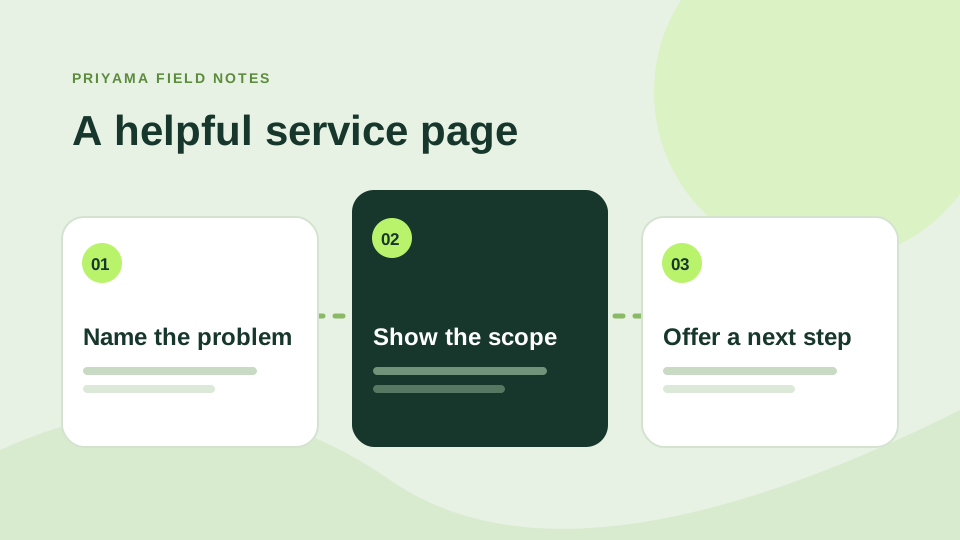
End with one clear action: book a call, request a review, or send a brief. Google also recommends people-first content that leaves readers with enough information to achieve their goal. A useful service page does exactly that.
Make the scope tangible
A useful service page gives people enough detail to decide whether to talk. Describe the outcome you are trying to help with, the work included, the handoff points and what you need from the client. For web design, that might mean content planning, page design, mobile testing and launch support. If copywriting or hosting is separate, say so.
Give the reader a next step that fits their stage. “Request a review” feels lighter than “Buy now” when the project still needs scoping. See our landing-page check if the page will receive paid traffic.
A small example beats a big claim
Examples are most useful when readers can see the problem, the approach and the result. If you show a concept instead of a live client project, label it clearly. If you quote a customer, make sure the words and attribution are approved. The goal is to help someone judge the work, not to fill space with generic praise.
If you change three things
- Say who the service is genuinely for.
- List what is included and what is separate.
- Make the first enquiry feel easy.